
This article was originally posted on LinkedIn. Follow us for more articles like this!
Every so often, an email lands in your inbox that reminds you why you do this work. Recently, I received a message from Paul Mirek, a dedicated English Language Arts teacher on Chicago’s southwest side and a Writing Apprenticeship alum. His reflections beautifully capture what happens when educators reimagine writing instruction—not as a checklist of standards, but as an art form that belongs in every discipline.
“Writing Apprenticeship was the best PD I’ve had in the second half of my career.”
Those words alone made my week. But what really struck me was the story that led to them.
From Professional Development to Professional Transformation
Paul had been exploring “Trust the (Writing) Process,” one of our new apps designed to help teachers teach process-based writing. He noticed right away that the tool wasn’t just for English teachers:
“It can help early-career teachers, but it also lends itself to subject areas that might not traditionally consider the writing craft.”
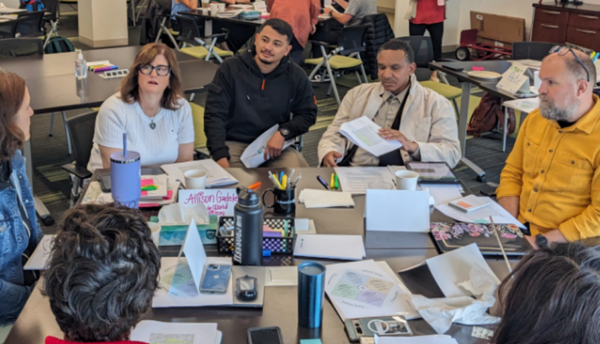
That insight was also reflected in a back-to-school all-staff professional learning workshop that Paul co-led with his colleagues, Jennifer and Stella. Their session focused on one deceptively simple concept—audience.
During their workshop, they presented how an audience matters in every outward-facing written product and presentation project. They knew their workshop was a success when the Physical Education department joined the conversation, sharing how a small tweak like considering the audience (e.g., inviting students to present their fitness plans to a younger grade level) could completely change student engagement and effort. In a follow-up to their workshop, Paul learned that in PE classes, small groups of students first video-recorded correct form and technique for weight-room exercises and then wrote a purposeful script that was recorded and added to the video file. The goal was to provide a video tutorial for an audience who was looking to learn these weight-lifting exercises correctly and to avoid injury. Importantly, their scripts addressed both concerns.
That’s the heart of Writing Apprenticeship: helping educators see that purpose and audience are entry points to authentic writing in every subject area.
Writing as Communication (and as Art)
Paul’s team carried this thinking directly into their ELA classrooms. They redesigned their first quarter units around the theme of “audience in all communication.” Students began by writing letters to their teachers—an act of writing grounded in audience awareness. Then, as they read The Kite Runner, they analyzed how Khaled Hosseini appeals to his readers. Finally, they wrote their own narratives, studying New York Times Young Author mentor texts for inspiration.
“Students produced some of the most beautiful pieces,” Paul shared.
But my favorite part of his reflection came next:
“I shifted the way I refer to my class: it is not simply an English class, but an English Language ARTS class. This emphasis helped students recognize that their narrative was a piece of art to share with others.”
That reframing, seeing writing as a communicative art to be shared with an authentic audience, captures the very soul of Writing Apprenticeship.
Why It Matters
What moves me most about Paul’s reflection is not just his success story. It’s the reminder that the real work begins after a professional learning series. When teachers internalize new ways of thinking about writing, and commit to retrofitting their units of study, their classrooms transform into spaces where students see themselves not just as learners, but as powerful creators within each discipline.
At Writing Apprenticeship, that’s our vision:
- Writing that serves real audiences.
- Learning that honors discipline-specific purposes.
- And teaching that helps both educators and students make their thinking visible to themselves and others.
Your Turn
Paul’s story reminds us that when teachers view writing as an authentic act of communication, students rise to the occasion. If his reflection resonated with you, share your thinking in the comments.
And if you’d like to learn more about how Writing Apprenticeship supports teachers in bringing authentic, real-audience writing into every classroom, reach out—we’d love to connect.
This article was collaboratively written by Jenell Krishnan and Paul Mirek.
Post Date
November 20, 2025